
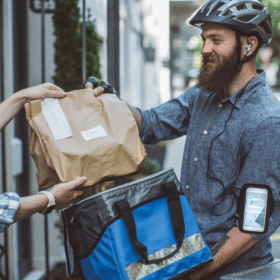
Third-party delivery has come a long way from its early pandemic days as a lifeline for restaurants navigating lockdowns and capacity restrictions. What started as a survival tool has become a permanent fixture of the restaurant business model.
The U.S. online food delivery market has grown rapidly over the past several years, and industry projections suggest it will more than double in size over the next decade. Major platforms like DoorDash and Uber Eats dominate the landscape, and for many restaurant concepts, it is now common for 25% to 30% of total revenue to flow through delivery channels. That growth has created real opportunity: expanded customer reach, incremental sales, and a way to fill kitchen capacity during off-peak hours. But it has also introduced a unique set of financial and operational complexities. For restaurant owners, understanding those complexities is important for day-to-day profitability. For anyone involved in buying or selling a restaurant business, it is essential.
Read Also: Accounting For Delivery Fees
The Cost Of Convenience
Let's start with the economics. Third-party delivery platforms typically charge commission fees ranging from 15% to 30% per order, depending on the level of service and visibility a restaurant selects. On top of that, restaurants often absorb payment processing fees, promotional costs, and packaging expenses that can push the true all-in cost well above the base commission rate.
We all know restaurants operate on thin margins to begin with. Even well-run operators typically earn somewhere around 10% to 12% on every sales dollar. So when a third-party platform is taking 25% to 30% off the top, those delivery dollars are worth meaningfully less than a dine-in or carry-out sale. Many operators respond by raising prices on their delivery menus, sometimes by 20% to 30%, but that only goes so far before customers start to go elsewhere.
Delivery can be a genuine value-add when it fills unused kitchen capacity, when delivery menu pricing is set strategically, and when the volume is truly incremental, not simply shifting customers who would have otherwise dined in or picked up their order. But when those conditions are not met, delivery can quietly reduce the profitability that makes a restaurant attractive in the first place.
Key Considerations For Buyers & Sellers
Not All Revenue Is Created Equal.
When delivery represents a significant share of a restaurant's sales, it is critical to understand the margin profile of that channel compared to dine-in and carry-out. A restaurant showing strong top-line growth may tell a very different story once delivery commissions and related costs are properly isolated. Separating delivery revenue from other sales channels helps determine the true earnings power of the business.
Sales Tax Can Be A Hidden Exposure.
Third-party delivery has created a new frontier of sales tax complexity. Marketplace facilitator laws vary by state, and the question of who is responsible for collecting and remitting sales tax, the restaurant or the platform, is not always straightforward. Adding local food and beverage taxes to the mix creates further inconsistency, as many delivery platforms may collect state-level sales tax but not local taxes, leaving the restaurant on the hook.
Who Owns The Customer?
One of the most overlooked aspects of third-party delivery is the customer relationship. In most cases, the delivery platform retains the customer data, which includes the ordering history, contact information, and preferences. That means the restaurant is essentially renting access to its own customers. Heavy dependence on third-party platforms for customer acquisition signals a risk: if the platform changes its terms, raises fees, or adjusts its algorithm, the restaurant's revenue could be directly impacted without a loyal, direct customer base to fall back on.
Platform Dependency.
When 30% or more of a restaurant's revenue flows through one or two delivery platforms, dependency itself becomes a consideration. Key questions include how commission rates and promotional terms have changed over time, what the contractual renewal and termination provisions look like, and what would happen to the business if the platform relationship were to deteriorate.
Preparing For A Transaction
For restaurant owners who may be considering a sale or recapitalization in the coming years, treating delivery as a focused area of preparation can reduce surprises and support value. A few practical steps to consider include:
- Building channel-level financials that separate dine-in, carry-out, first-party delivery, and third-party delivery. Reconcile them to the general ledger and platform settlement statements.
- Reviewing and documenting your revenue recognition policy by examining your third-party delivery contracts and ensuring your accounting policies and records are aligned.
- Reconciling platform settlements on a regular basis, including gross sales, commissions, marketing spend, refunds, chargebacks, and taxes, to identify and resolve discrepancies early.
- Understanding your sensitivity to delivery economics by thinking through how changes in delivery mix, pricing, or commission rates would affect your profitability. Knowing where delivery adds value and where it starts to work against you would be crucial in a transaction.
- Developing a clear channel strategy that balances third-party and first-party ordering, with a roadmap for how you plan to manage delivery costs and build direct customer relationships over time.
The Takeaway
Third-party delivery is neither inherently good nor bad for a restaurant business. These platforms can drive customer acquisition and incremental sales, or they can erode unit economics; it depends on pricing strategy, management discipline, and how well the channel is integrated into the broader business. Regardless of the utilization of third-party delivery services, a clean and well-supported delivery story can provide tremendous value when going through a sales process. For buyers, an analysis of delivery economics is crucial to understand true profitability trends.
For more information on how delivery economics may be affecting your business, or to discuss how GBQ can support your next transaction, contact a member of GBQ's Transaction Advisory Services and Restaurant Services teams.
Looking for additional Transaction Advisory Services insights? Check out these resources:
Financial Reporting Issues To Consider In ‘Going Private' Transactions
Navigating The Path To Going Private: Understanding SEC Requirements
From Fork To Fund: Preparing To Take On Private Equity Investment